$MONA | DIGITALAX
What's A Token?
A token, in this context, is not a "bet" or a "price chart." It is a unit the system can move. A small, exact piece of state that can be transferred, locked, split, combined, referenced, or consumed inside a workflow. It sits at the same level as signatures and hashes, but instead of anchoring what happened, it enables what can happen next.
Think of it as a marker that can be routed through a sequence of actions.
In a web3 fashion pipeline, the designer is already working with pattern states, machine execution, and bounded buyer interactions. Tokens enter when there is a need to coordinate flows across those surfaces.
A pattern is published. That is static.
A garment is produced. That is static.
A relationship, a sequence, a condition - those require movement.
Tokens carry that movement.
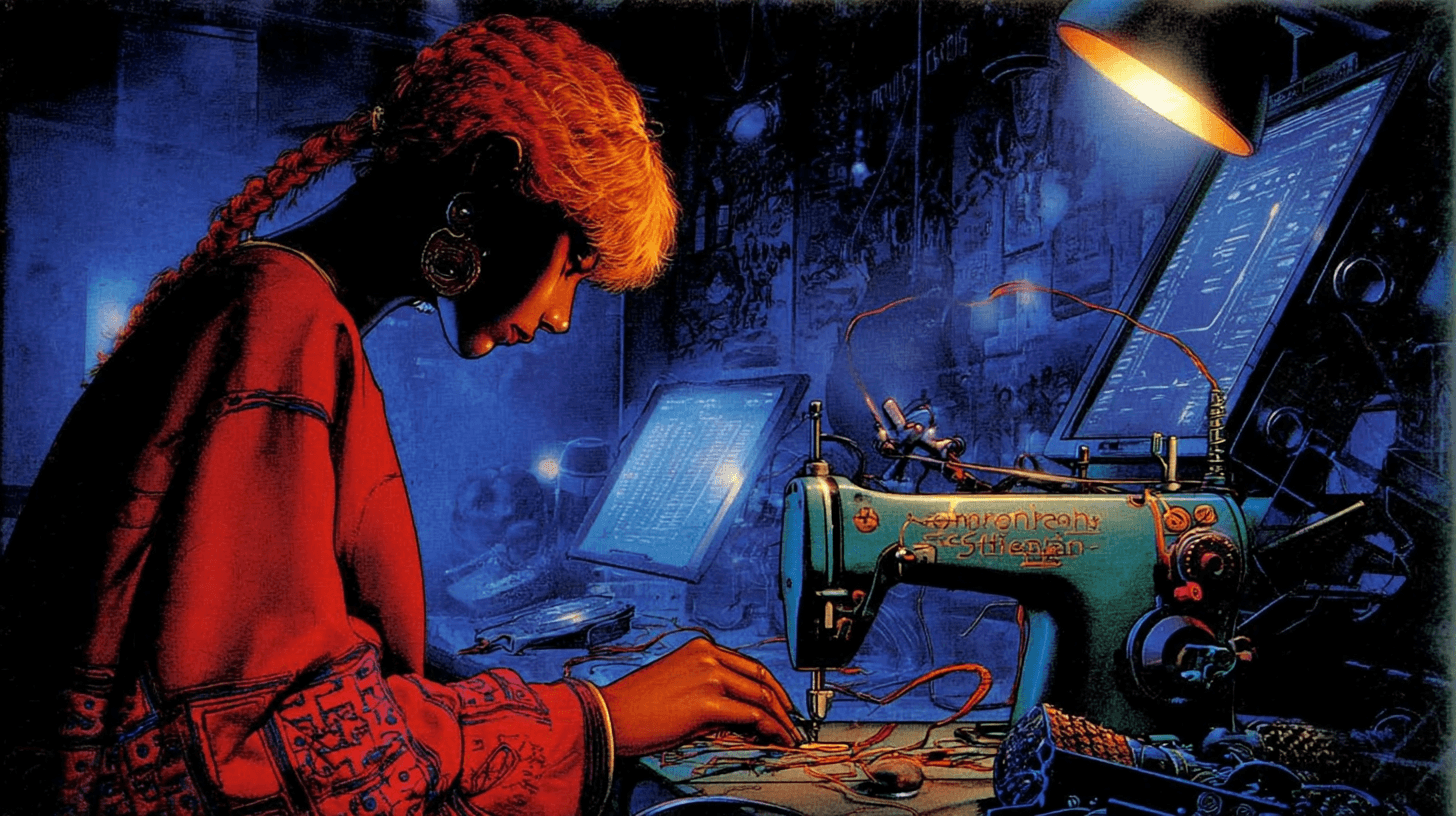
A token can represent a position inside a process. Not ownership of a file, but participation in a sequence. A designer can issue a small set of tokens tied to a specific pattern lineage or garment run. These tokens can be used to enter a future step - requesting a custom piece, accessing a fabrication slot, contributing to a new variation, or triggering a private interaction.
The important detail is that the token is not descriptive. It is operational.
It can be consumed to unlock a path.
It can be routed into another contract.
It can be split into smaller units and distributed.
It can be locked to signal commitment.
It can be measured to define weight inside a decision.

This is why tokens sit alongside conditional encryption.
Encryption defines who can see or compute on something.
Tokens define how actions are sequenced and accounted for.
Now connect this to the point about agents and workflows.
An agent is not a thinking entity. It is a function bound to a sequence of steps. A workflow is a graph of these steps. Inputs come in, transformations occur, outputs are produced. The intelligence is in how the steps are arranged and how state flows between them.
Tokens become the units that move through that graph.
A token enters a workflow.
It triggers a step.

It is transformed, split, or consumed.
It exits as another token or as a completed action.
This is very close to how transistors form circuits. A single transistor does nothing meaningful. A sequence of them produces computation. A single token does nothing meaningful. A sequence of token flows produces coordination.
For a designer, this becomes concrete.
She publishes a pattern. That is CC0.
She defines a fabrication window - ten slots for a specific material run.
Instead of managing this manually, she creates ten tokens.
Each token corresponds to one slot in that run.

A buyer acquires a token. That token is then used to:
submit measurements through an encrypted channel
trigger the generation of a custom pattern instance
reserve machine time in her local setup
Once the garment is produced, the token is consumed or transformed into a different token representing the completed piece.
No spreadsheets. No platform queue. The token moves through the workflow and enforces the sequence.
Now extend this.
She runs multiple pattern threads. Each thread has its own token flow. Some tokens grant access to experimental outputs. Others route into collaborative workflows where multiple designers contribute. Tokens can be pooled to fund a material batch or a machine upgrade. They can be staked into a shared fabrication network to gain priority or access.

This is where tokens stop being isolated and start interacting.
A token from one workflow can be accepted as input in another. That is interoperability. Not at the level of branding, but at the level of execution. One designer's output becomes another designer's input because the token is a compatible unit.
Now tie it back to confidential computing.
A buyer holds a token. They want to trigger a custom garment.
They submit encrypted data.
The system verifies that the token is valid.
The computation runs on their data.
The output is produced.
The token enables the sequence. The encryption protects the data. The two do not overlap. They operate on different surfaces.
This also addresses the illusion of learning.

The system does not learn from each interaction in the sense of updating a global model. It updates state. Context, memory, workflow position. Tokens are part of that state. They carry forward what has been done and what can be done next.
A workflow improves when its structure improves.
An agent improves when the sequence it participates in is refined.
Tokens help structure that sequence in a way that can be executed, measured, and composed with other sequences.
Now bring it back to the designer's sovereignty.
Without tokens, the system can describe relationships, but it cannot execute them. It cannot:
reserve capacity
distribute access
route value
coordinate multiple participants
With tokens, these become native operations. The designer defines flows that run without needing a central coordinator.
A decentralized storefront, in this sense, is not just a display. It is a routing interface. It shows pattern states, garment references, and available tokens. A buyer interacts by moving tokens into workflows, not by filling out a form inside a closed system.

And this is where the earlier point lands clearly:
A protocol cannot coordinate activity with descriptions alone.
It needs units that move.
Tokens are those units.
For a web3 fashion stack, that means:
Patterns define form.
Signatures define placement.
Encryption defines boundaries.
Proofs define conditions.
Tokens define flow.
When those are aligned, the designer is not running a shop in the traditional sense. She is running a set of executable processes where materials, machines, people, and data all move through well-defined paths.
And the value is not in the token itself.
It is in the sequence the token participates in.